
TeamDev Ecosystem has partnered with the University of Perugia’s Department of Agricultural, Food, and Environmental Sciences (DSA3) to develop the technological core of the LIFE OliVER (OLIve tree for Verified Emission Reduction generation) project, a 3-million-euro international initiative operating at the intersection of AgTech, carbon farming, and the voluntary carbon credit market.
The project involves pilot olive-growing farms in Italy (Umbria), Greece, and Spain, spanning the entire Mediterranean basin, and includes a field development and validation process that will continue through September 2027, with the platform undergoing constant evolution throughout the duration of the initiative.
Initial Situation
The Mediterranean olive sector, in addition to representing a historical, landscape, and economic heritage that defines the region’s identity, possesses immense biological potential that has not yet been monetized: the capacity to sequester atmospheric CO2. However, olive growers have historically faced structural barriers that prevent them from transforming this environmental value into a tangible economic resource.
The main challenges of the initial situation:
- Lack of tools: the absence of standardized, scientifically validated agronomic technologies or tools to independently, rapidly, and rigorously quantify the impact of sustainable practices.
- Disconnected worlds: advanced scientific research on carbon sequestration and day-to-day practices in the field remained two separate realities, lacking a “digital bridge” that would allow farmers to assess the economic benefits of ecological choices in real time.
- Bureaucratic complexity: the absence of a harmonized regulatory framework for olive cultivation aligned with European standards, and high bureaucratic complexity in accessing the voluntary carbon credit market.
It is within this context that the international LIFE OliVER project—coordinated by DSA3 at the University of Perugia—was launched to bridge this gap and guide Umbria and Europe toward new models of carbon farming.
The Technology Used and Why
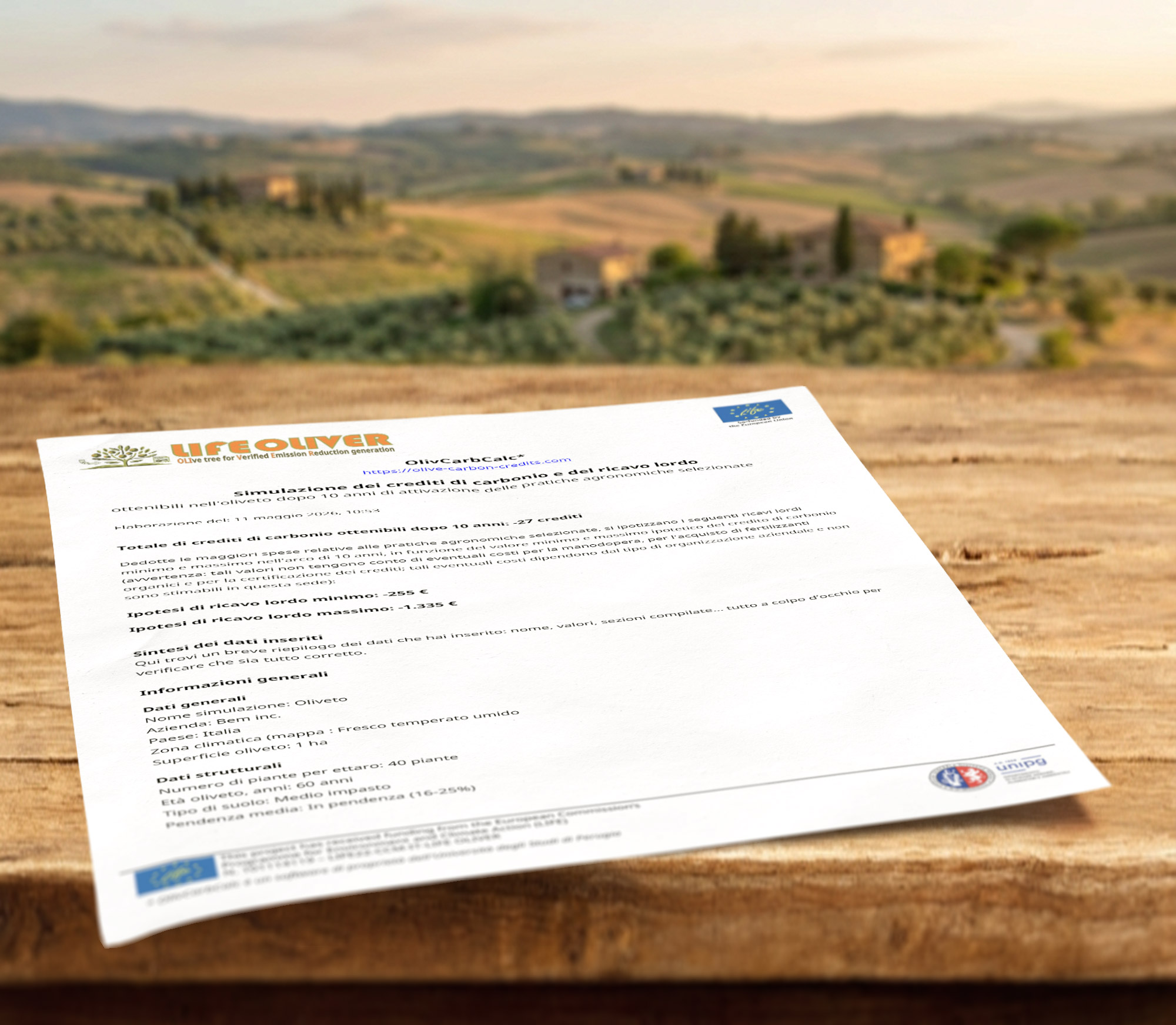
To bridge this gap and transform scientific research into a practical tool for use in the field, TeamDev Ecosystem has developed the technological/digital core of the LIFE OliVER project: an advanced digital platform centered on the dedicated OlivCarbCalc web app.
The decision to develop a cloud-based solution accessible via a web app is based on three fundamental strategic pillars:
- Democratization of Scientific Research / Ease of Use: OlivCarbCalc translates the complex calculation algorithms developed by the DSA3 at the University of Perugia into a simplified and intuitive user interface. With just a few clicks, farmers can simulate the adoption of sustainable agricultural practices and instantly estimate CO2 sequestration and the potential for generating carbon credits. The tool breaks down technical barriers by translating complex scientific calculations into immediate estimates.
- Rigor and Standardized Certification: Unlike generic estimation tools, TeamDev’s technology natively integrates a standalone protocol for olive cultivation. This calculation engine is strictly aligned with the most stringent international standards (ISO 14064-2, ISO 14068) and ICROA (International Carbon Reduction and Offset Alliance) requirements. This ensures that every calculated data point is scientifically sound and verifiable.
- Future-Proof Design (EU Compliance) / “Future-Proof” Engineering: The platform’s backend is already engineered to comply with the European Union’s guidelines on carbon farming, allowing the collected data to flow directly into the EU’s Official Registry scheduled for 2028. This puts users/farms in a clear competitive advantage (“pole position”), ensuring that their credits are ready and compliant with EU regulations.
Technical Specifications
| Componente Tecnologico | Function and Architectural Value |
| OlivCarbCalc Web App | Self-service agronomic simulator for estimating the potential for generating carbon credits. |
| ISO/ICROA Calculation Engine | Algorithms certified as compliant with ISO 14064-2 and 14068 standards and ICROA compliance requirements. |
| Preparation for the 2028 EU Registry | A data structure natively aligned with future European standards for registry interoperability. |
Benefits for Users of the Solution
The introduction of the technology platform within pilot companies—which cover an initial area of approximately 1,000 hectares (nearly 1,000 hectares in total) across Italy, Greece, and Spain—generates multifaceted benefits, both economic and environmental:
- Supplementary Income and New Revenue Streams.
Thanks to the carbon farming model enabled by OlivCarbCalc, carbon sequestration is no longer just an environmental indicator but becomes a genuine asset on the company’s balance sheet—it shifts from a moral obligation to an asset on the balance sheet. Olive growers can generate certified and guaranteed credits to sell on the voluntary market, receiving direct compensation and monetizing their work based on the environmental value they produce. - Agronomic Optimization and Cost Reduction
The guided application of the project’s methodologies supports farmers in their transition to more efficient practices: targeted reduction in the use of chemical fertilizers, improvement of soil fertility, and conservation of organic matter. This translates into a direct reduction and optimization of olive grove management costs. - Regional Sustainability and Landscape/Biodiversity Conservation
In addition to economic returns, adopting the protocol increases biodiversity in agricultural areas and boosts the overall (long-term) profitability of olive groves, providing farms with the financial resources needed to protect and preserve historic and traditional Mediterranean olive-growing landscapes, such as those in Umbria.
Quote
“The LIFE OliVER project fully embodies one of the most important objectives of our Department’s scientific mission: to generate innovation with tangible benefits for agricultural businesses and environmental sustainability, but also to network and collaborate with local businesses—in this case, farms—as well as a major local company engaged in the digitization of production facilities.” — Prof. Antonio Boggia, Director of DSA3, University of Perugia
Learn More
To learn more about the project’s objectives, partners, and expected results, please visit the coordinator’s official page: OLIVER LIFE Project – Department of Agricultural, Food, and Environmental Sciences. The OlivCarbCalc web app is available at olive-carbon-credits.com.